
Which Artificial Plant Material Delivers Superior Realism?
Every artificial plant engineer faces the same fundamental question at the start of a new product development cycle: Which Artificial Plant Material will deliver the most convincing botanical replica? For decades, the answer seemed straightforward—silk (polyester fabric) was the gold standard for realism, while polyethylene (PE) was the durable but visibly artificial alternative. But the landscape has shifted dramatically.
Today’s manufacturing technology has evolved from simple silk printing to 3D modeling and advanced material composites. The distinction between PE and silk is no longer a simple binary of “realistic vs. durable.” It is a nuanced engineering decision that involves material science, process selection, surface treatment, structural design, and application environment.
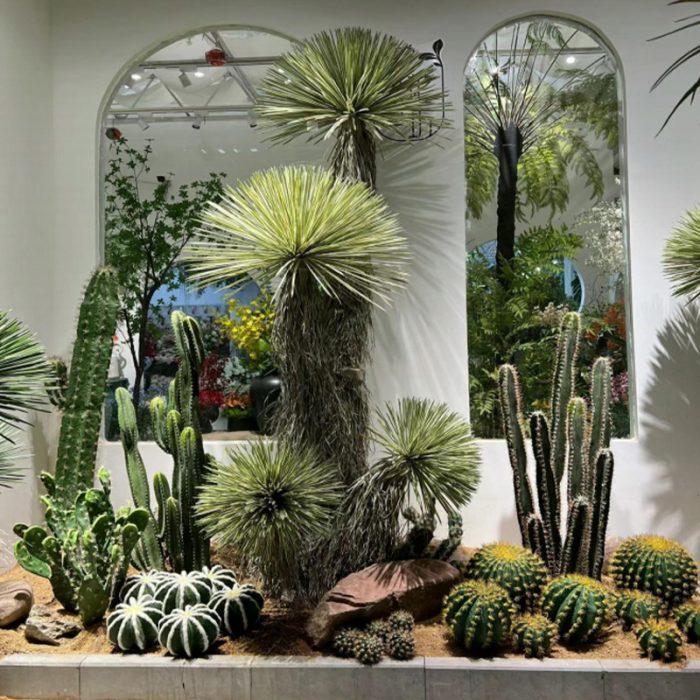
Artificial Plant Material type
Today’s “silk” flowers are manufactured from woven or non-woven polyester fabrics, dyed, printed, and heat-formed into petal and leaf shapes. Polyester fabric offers several inherent advantages for floral applications. It accepts dyes readily, enabling subtle color gradients that mimic natural petals. The woven structure creates slight translucency—light passes through the material much as it does through real petals, a quality that PE, being opaque, cannot replicate. Layered polyester with gradient dyeing creates the color depth and slight translucency that makes a fabric rose petal convincing.
Silk fabric provides soft textures and flexible color customization. It can be cut, shaped, and layered to create complex flower forms with multiple petal layers—rose blooms, peonies, hydrangeas—that would be prohibitively expensive to produce in molded plastic.
Today’s “silk” flowers are manufactured from woven or non-woven polyester fabrics, dyed, printed, and heat-formed into petal and leaf shapes. Polyester fabric offers several inherent advantages for floral applications. It accepts dyes readily, enabling subtle color gradients that mimic natural petals. The woven structure creates slight translucency—light passes through the material much as it does through real petals, a quality that PE, being opaque, cannot replicate. Layered polyester with gradient dyeing creates the color depth and slight translucency that makes a fabric rose petal convincing.
Silk fabric provides soft textures and flexible color customization. It can be cut, shaped, and layered to create complex flower forms with multiple petal layers—rose blooms, peonies, hydrangeas—that would be prohibitively expensive to produce in molded plastic.
Polyurethane (PU) is widely used in “Real Touch” applications. A PU coating applied over fabric or foam cores creates a soft, realistic petal texture. Unlike standard silk flowers that feel papery, Real Touch products feel similar to fresh flower petals. Latex coatings offer an even softer feel, best for close-up applications, while PU coating provides greater durability for commercial installations.
Thermoplastic Elastomer (TPE) combines rubber-like softness with plastic processability. It offers soft touch, good elasticity, and resilience, similar to rubber but processable like ordinary plastics. TPE is increasingly used for artificial succulent leaves and artificial fruit, where a fleshy, rubbery texture is essential for realism.
PVC (Polyvinyl Chloride) remains a durable, cost-effective option for stems and structural components. PVC leaves can be printed with embossed vein details, and PVC stems with internal wire cores provide adjustability. However, PVC’s slightly shiny surface can appear less realistic than PE or silk under direct light.
EVA Foam (ethylene-vinyl acetate) is a specialist material for succulent leaves and tropical foliage. It offers the slightly waxy, semi-rigid character of real tropical plants. EVA takes pigment well, can be finished to a realistic matte or subtle gloss, and holds its three-dimensional shape without the stiffness of rigid plastic.
Flocking—the electrostatic application of short fibers—creates specialized surface effects. Flocking material is a coating of thousands of tiny fibers, typically 1 to 3 millimeters long, applied upright onto an adhesive-covered surface. It is used to simulate frost, dust, moss, or the velvety texture of certain plant surfaces.
Artificial Plant Material Manufacturing Processes
The PE Injection Molding:
Injection molding is the primary manufacturing method for PE artificial plant components. The process begins with a mold—ideally created from a 3D scan of a real leaf or plant specimen, capturing every surface detail: veining, texture, and natural curvature. Granules of PE (often with UV stabilizers pre-blended) are melted and injected into the mold cavity under high pressure.
The mold itself determines the level of realism achievable. For fine patterns such as leaf veins and petal textures, high-precision tooling is essential. The resulting PE component, when properly finished with multi-layer pigment, can be nearly indistinguishable from the original.
Injection molding offers several engineering advantages:
Consistency: Each leaf is identical, enabling precise quality control.
Complex geometry: Three-dimensional shapes with embossed veins and natural curvature can be achieved in a single molding step.
Material integration: UV stabilizers, colorants, and flame retardants can be blended directly into the polymer.
Scalability: Multi-cavity molds produce hundreds of components per cycle.
The injection molding process is optimized for PE and PP materials, effectively solving common molding challenges such as insufficient filling of thin-wall parts.
The Silk Heat Pressing and Die Cutting:
Silk and polyester flowers follow a fundamentally different manufacturing path. The process begins with die cutting—fabric layers are stacked and placed in a cutting die for punching to form the prototype of the petals. This is a subtractive process, removing material to create shape, rather than the additive approach of injection molding.
Heat pressing (also called heat sealing) is where fabric flowers gain their three-dimensional form. The cut fabric blanks are placed in a heat sealing machine, with heating temperatures controlled to achieve the desired shape. For more advanced materials, such as PU, components are formed by pressing upper and lower molds together. The surface texture of the petals is processed by a hot pressing shaping device to give it an uneven curve and increase the sense of reality.
Heat pressing typically requires temperatures of 150-200°C for embossing fabric leaves. This process creates the embossed vein details that distinguish premium silk flowers from cheap imitations. The heat sets the fabric into a permanent three-dimensional shape, complete with curves, folds, and textures.
Foam Molding and Specialized Processes:
Foam molding is used for PU foam tree trunks, foam bases, and certain flower heads. The process involves injecting foam material into a mold where it expands and cures, creating lightweight yet structurally sound components.
Ultrasonic welding is employed for attaching plastic leaves to petioles without adhesives. Heat shrink fixing wraps wire joints with heat shrink tubing for clean, durable connections.
Artificial Plant Material Surface Treatment
Surface treatment is where the engineering choices of material and process are translated into visual and tactile realism. The difference between a convincing botanical replica and a visibly artificial decoration often comes down to surface finishing.
Spray Painting and Airbrushing
Spray painting and airbrushing are critical for achieving natural color transitions. High-end artificial flowers feature darker tones at the center and lighter shades at the edges—just like nature. Cheap versions use flat, uniform colors that look obviously fake.
The factory process involves multiple layers of hand-applied pigment, not just one coat of dye. This careful color work is what makes artificial plants look believable under natural light. Gradient and ombre effects—commonly found in artificial hydrangeas and roses—are achieved through skilled airbrushing techniques that blend colors seamlessly.
Matte vs. Gloss Finish
The choice between matte and gloss finish has profound implications for realism. A matte, slightly powdery finish is almost always more realistic than a high-gloss, plastic-looking surface. Real leaves have a subtle, non-reflective quality that a matte finish replicates effectively. High-end versions use matte finishes and sometimes velvety textures that feel soft to the touch.
A gloss finish can be appropriate for certain species—plants with naturally waxy leaves, such as many tropical varieties—but is often overused on low-quality products. The glossy sheen is precisely what makes many artificial plants “read as synthetic in photographs,” particularly in direct sunlight or near windows.
UV Coating and UV Resistance
UV coating and UV resistance represent a critical engineering distinction. There are two approaches to UV protection:
Built-in UV inhibitors are infused into the material—like high-quality polyethylene—during the manufacturing process. UV-resistant chemicals and stabilizers are blended into the polymer, distributing protection throughout the material. This integrated approach provides vastly superior and longer-lasting results compared to surface treatments. Built-in protection maintains effectiveness for 5-10 years of outdoor exposure.
Surface UV coatings are applied to the plant after production. These offer moderate UV protection but require regular reapplication, as exposure to rain and weather can wear them away. Surface coatings are a less durable, cheaper alternative.
For engineers specifying materials, the choice is clear: built-in UV stabilization is essential for any artificial plant destined for outdoor use or bright indoor spaces. The difference between treated and untreated product over a two-year period near a south-facing window is dramatic.
Flocking and Specialized Finishes
Flocking—the electrostatic application of short fibers—creates specialized surface effects. The process involves charging fibers and applying them to adhesive-coated surfaces; the fibers stand upright due to electrostatic forces, creating a uniform, dense, and textured surface. Flocking is used to simulate:
Frost and snow effects: White flocking mimics winter frost on foliage.
Moss and grass textures: Green flocking creates realistic mossy surfaces.
Velvety textures: Certain plant species with fuzzy leaves are replicated through flocking.
Dry brush highlighting applies light colors to leaf edges or trunks, creating the subtle variations that make a plant look alive. Simulated dew uses transparent gel beads or clear adhesive dots to create water droplets on leaf surfaces—a detail that can dramatically enhance perceived realism.
Artificial Plant Material influences structural
PE’s rigidity versus silk’s flexibility dictates how branches are engineered, how products are packaged, and how they perform in different environments.
Bendable stems are achieved through internal wire cores—typically iron wire or aluminum wire—that allow positioning and repositioning without breaking. The wire is wrapped or coated with the primary material:
Paper wrapped wire is common for single flower stems.
Plastic coated wire offers rust-proofing for outdoor applications.
Fabric wrapped wire provides a natural appearance for silk flowers.
The stem framework determines how an artificial plant looks when arranged and how long it lasts. Steel wire cores wrapped in fabric or bark-finish coatings allow bending and repositioning without snapping—essential for achieving natural-looking arrangements. Rigid plastic branches can’t be adjusted and break when stressed.
Knock-down structure has revolutionized how artificial trees are shipped and stored. A knock-down construction allows branches to be detached or folded, reducing carton dimensions and improving container utilization.
Hinged foldable branches fold down to reduce height for packaging. This design—common in artificial Christmas trees—allows branches to be unfolded and positioned at the desired angle. The tree consists of multiple articulated components that can be easily assembled. Hinged construction makes the artificial tree quick to assemble, expanding easily without much time and effort.
The choice of connection system affects assembly time, structural integrity, and user experience:
Plug-in connections: Branches insert into the main stem socket—simple and tool-free.
Screw-in types: Branches are secured with screws for greater stability.
Snap-fit / Clip-on: Leaves or flower heads clip into branches for rapid assembly.
Connector tubes / Joiners: Used for segmented tree trunks, allowing height adjustment.
PE’s structural rigidity makes it well-suited for plug-in and screw-in connections that maintain their integrity over time. Silk’s flexibility requires different engineering approaches, often relying on wire-wrapped stems that can be bent but not securely snapped into place.
Artificial Plant Material Head-to-Head Comparison
Silk (Polyester) wins for flowers, PE wins for foliage.
Silk’s ability to accept gradient dyeing and its slight translucency make it the superior choice for flower petals. A quality artificial flower has darker tones at the center and lighter shades at the edges, just like nature. The woven fabric structure creates subtle color variations that molded plastic cannot replicate.
PE, however, excels at foliage. When a mold is created directly from a real leaf specimen, capturing every surface detail, the resulting PE component can be nearly indistinguishable from the original. PE leaves have a slight waxy coating that mimics the texture of real leaves. For ferns, palms, and succulents, PE is the material of choice.
PE (especially Real Touch PE) wins for foliage; Real Touch (PU/latex-coated) wins for flowers.
Standard PE has a firm, slightly shiny feel that can betray its artificial origin. However, Real Touch PE uses additional soft-touch processing to create a smoother surface and a more natural leaf feel.
For flowers, Real Touch technology—using latex or PU coatings—creates a soft, realistic petal texture. Unlike standard silk flowers that feel papery, Real Touch products feel similar to fresh flower petals. The coating gives the petal a slightly cool, velvety feel and a substantial, rubbery thickness that mimics the actual structure of a natural petal.
PE is highly durable, UV-resistant when properly formulated, and easy to clean. A quality PE plant can last 5-10 years indoors without significant color shift. PE is the right material for outdoor-rated artificial plants.
Silk (polyester) has medium durability. It can fade over time and is less durable outdoors. When silk degrades in humidity, it rots and molds. Silk is not suitable for high-traffic commercial areas because fabric collects dust and loses shape faster than PE.
PE with built-in UV stabilizers resists sun degradation for years. The UV inhibitors are blended into the raw material, ensuring the entire product is protected, not just the surface.
Silk fabric, even with UV treatment, fades more quickly. Untreated fabric fades within months when exposed to direct sunlight. Silk’s fiber structure is inherently more susceptible to photodegradation than PE’s polymer matrix.
Silk wins for complex, multi-layered designs; PE wins for volume and consistency.
Silk’s die cutting and heat pressing processes allow for intricate, layered flower constructions with multiple petal shapes and sizes. Each flower can be assembled from dozens of individually cut and shaped components.
PE’s injection molding excels at volume production with consistent quality. However, creating a new mold is expensive—new tooling requires significant upfront investment. Once the mold is made, however, production is fast, consistent, and cost-effective.
Standard PE is generally more cost-effective for foliage; premium Real Touch and high-end silk are more expensive.
Basic PE is an affordable option for large-volume production. However, high-quality PE with Real Touch processing commands a premium. Silk flowers occupy a middle ground—more expensive than basic PE but generally less expensive than Real Touch PE.
Artificial Plant Material Application-Specific Recommendations
PE’s durability and UV resistance make it the clear choice for outdoor use. Look for products with UV stabilizers infused into the polymer during manufacturing, not surface coatings that will wear off.
For close-up viewing and tactile experience, Real Touch technology delivers the most convincing flower petals. High-quality silk with gradient dyeing and heat-pressed textures is also excellent for indoor floral arrangements.
For Commercial and High-Traffic Areas, Choose PE.
PE’s durability and ease of cleaning make it suitable for commercial spaces. Silk is not suitable for high-traffic commercial areas because fabric collects dust and loses shape faster than PE.
For Large Floor Plants and Trees, Choose PE for foliage; consider PU foam for trunks.
PE’s structural integrity makes it ideal for large floor plants. PE leaves maintain their shape and resist handling damage. For trunks, PU foam with artificial bark finishes provides realistic texture and weight without the expense of real wood.
For Delicate Flowers and Arrangements, Choose silk or Real Touch.
For roses, peonies, hydrangeas, and other flowering plants, high-quality polyester and silk blends are the standard. These materials allow for subtle color gradients that mimic real petals.
For foliage—ferns, palms, succulents, hedge, broad-leaf tropical plants—PE (particularly Real Touch PE) delivers superior realism. The ability to capture every vein, texture, and natural curvature through injection molding from real plant specimens, combined with multi-layer pigmentation and matte finishing, creates foliage that is visually and tactilely convincing.
For flowers—roses, peonies, hydrangeas—silk (polyester fabric) or Real Touch (PU/latex-coated) delivers superior realism. The fabric’s slight translucency, ability to accept gradient dyeing, and capacity for complex multi-layered construction make it the material of choice for convincing flower petals.
For outdoor applications, PE with built-in UV inhibitors is the only rational choice. Silk fades, degrades, and collects moisture in ways that make it unsuitable for exterior use.
For commercial and high-traffic applications, PE offers the durability and cleanability that silk cannot match.
The most sophisticated products increasingly combine materials—PE foliage with silk or Real Touch flowers, PE structural components with PU foam trunks, EVA foam succulents with flocked surface finishes. The engineer’s art lies not in choosing one material over another, but in selecting the right material for each component of the product.
As manufacturing technology continues to evolve—from simple silk printing to 3D modeling and “Real Touch” latex injection—the gap between artificial and natural continues to narrow. The question is no longer “which material is more realistic?” but rather “which combination of materials, processes, and finishes will deliver the required realism for this specific application?”
REQUEST QUOTE
Please fill out the form below and a representative will contact you. Thank you.
Sales Manager:Nina
Tel:
+86-19924394700
Email:
leafhometrade@gmail.com