
How to select artificial plant materials based on the usage environment?
Artificial plant materials include PE, PET, PVC, PP, silk, latex, EVA, paper cloth, PU, etc., each suitable for different grades and scenarios.
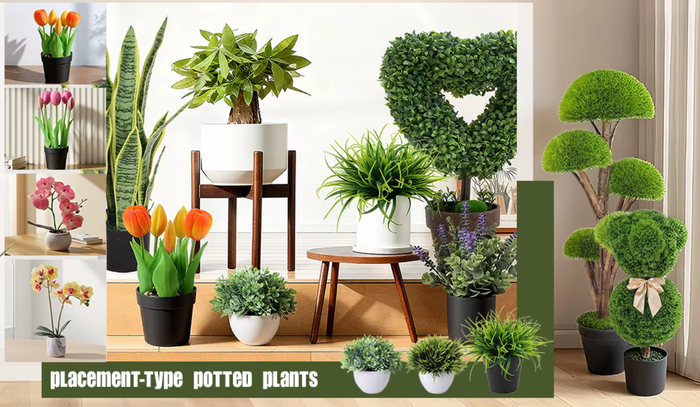
Comparison of the three main artificial plant materials: PE, PET, and PVC
① PE (Polyethylene) – Simulated Ceiling
- Physical Properties: Soft and fleshy texture, no creases, elastic feel close to real plants.
- Lifespan and Durability: Approximately 8-10 years indoors, 4-6 years outdoors; excellent UV resistance, even up to 15 years without fading.
- Application and Simulation: Widely used, it closely resembles the feel of real plants and has good weather resistance, and is often used for high-end simulated leaves, petals and large outdoor green plants. The simulation accuracy is the highest among all materials.
- Safety and Environmental Protection: Non-toxic and odorless; recyclable.
- Cost: Relatively high, belonging to the mid-to-high-end material category.
② PET (Polyester/Polyester Fiber) – Safe and Environmentally Friendly Choice
- Physical Properties: Essentially a fiber, soft texture, but with average resilience and prone to deformation.
- Lifespan and Durability: Specific lifespan depends on additives, but the base PET material will yellow and become brittle when exposed to sunlight.
- Applications and Realism: Mostly in fibrous fabric form, suitable for making petals, leaves, and other fabric parts of artificial flowers to mimic the soft texture of plants.
- Safety and Environmental Protection: Safe and non-toxic; currently, the PET recycling system is the most comprehensive.
- Cost: Moderate; raw materials are widely available (e.g., beverage bottles).
③ PVC (Polyvinyl Chloride) – A Cheap and Versatile Material
- Physical Properties: It can be made into soft or hard materials. When paired with a metal frame, it can simulate intricate shapes. However, it has a hard texture, a cheap plastic feel, and is not resistant to aging and is easily deformed.
- Lifespan and Durability: Generally shows signs of wear after 3-5 years. Without protection, base PVC may crack within 1-2 years, and prolonged exposure to sunlight will release harmful gases.
- Application and simulation level: Commonly used for mass production of low-cost artificial flowers, Christmas trees, branches, etc., and high-end products can also achieve a realistic texture.
- Safety and Environmental Protection: Stable and qualified PVC is safe, but inferior products may release harmful substances such as phthalates. Recycling is difficult.
- Cost: Lowest cost.
The guiding principle for selecting artificial plant materials: “First, consider the intended use case; second, consider your budget; third, consider safety.”
- For those seeking top-quality materials and durability (primarily indoors or high-end outdoor): PE is the first choice.
- If you have a sufficient budget and prioritize indoor environmental protection: high-quality PE or PET are excellent choices.
- For very limited budgets and short-term interior decoration: PVC is an option.
- For outdoor environments (balconies, gardens, etc.): PE material must be chosen, and the product must be clearly labeled “Anti-UV”. PET and ordinary PVC have a drastically shortened lifespan outdoors.
This chart compares the “commonality” and “characteristics” of common artificial plant materials to help you choose the right one for your needs.
I. Mainstream Thermoplastic Materials (The Most Common Substrates on the Market)
| Material | Core Features | Durability/Weather Resistance | Environmental Safety | Cost | Typical Uses |
| PE | Soft and thick, no creases, can be used for whole leaves | 8-10 years indoors, 4-6 years outdoors (UV resistant) | Non-toxic and recyclable | High | High-end artificial trees, outdoor green walls |
| PET | Fiber fabric feel, soft but easily deformed | 3-5 years indoors, yellowing and brittle outdoors | Non-toxic, mature recycling system | Medium | Simulated petals, leaf fabrics, low-cost flowers |
| PVC | Can be hard or soft, high cost-performance ratio, plastic-like texture | 3-5 years indoors, 1-2 years of aging outdoors | Inferior products may contain plasticizers | Low | Cheap artificial flowers, vines, Christmas trees, branches |
| PP | Stiff, smooth, fold-resistant | Long-term indoors, average outdoor | Food-grade safe, recyclable | Very low | Simulated succulents (rigid), plastic flower pots, artificial lawn base netting |
For realistic and durable PE, use PVC/PP for low-cost interior decoration; for PET that emphasizes the feel of fabrics.
II. Special Texture/High-End Simulation Types (for High-Quality Floral Art Reproductions)
| Materials | Characteristics | Applicable Scenarios | Precautions |
| Silk (Real Silk/Rayon) | Extremely soft, natural luster, classic traditional artificial flowers | High-end wedding floral arrangements, interior decoration | Not waterproof, easily attracts dust, short lifespan (approximately 1-2 years) |
| Latex | Covers a fabric skeleton, creating a realistic fleshy feel | Highly realistic orchids, succulents, tactile biomimetic plants | Susceptible to sun exposure; will age and become sticky over time |
| EVA (Ethylene-Vinyl Acetate) | Flexible and elastic, like soft rubber | Children’s handmade artificial flowers, toy plants | Not heat resistant, easily deformed |
| PU (Polyurethane) | Can simulate jelly texture or leather texture | Highly realistic fruits, artificial plant decorative plates | High cost, some formulas are toxic |
| Paper/Cloth (Cotton/Linen) | Environmentally friendly, artistic, but completely non-waterproof | Home decoration, photography props | Cannot be wiped clean, easily becomes brittle |
III. Artificial Plant Materials Specialized Materials for Specific Scenarios
Outdoor UV-resistant composite materials: Generally PE with a UV-resistant coating, with a few being PP with fiberglass (used for artificial turf).
Fire-retardant artificial plants: Flame retardants added to PVC or PET, used in fire-controlled areas such as shopping malls and hotels.
Biodegradable materials: PLA (polylactic acid) or starch-based materials; currently, these have low simulation accuracy and high cost, and are rarely used in commercial artificial plants.
IV. Artificial Plant Materials Purchase Recommendations Based on Usage
| If you want… | First Choice Material | Second Choice | Avoid |
| Most realistic plant material, for living room/office | PE | high-quality silk | PVC |
| Balcony/outdoor garden, sun and rain resistant | PE (clearly UV resistant) | no | PVC, PET, silk |
| Low-cost decoration, replace after one year | PVC or PP | PET | no |
| Wedding/photography props, used only once | silk or paper | no | no |
| Children’s room/kindergarten, safe and non-toxic | PE or PET | PP | inferior PVC (contains plasticizers) |
| Bathroom/humid environment | Plastics (PE, PVC) are all acceptable | no | silk, paper, latex |
If you already have an artificial plant, you can quickly test it yourself by following these steps. If you’re unsure what type of material it is, you can take pictures of the front and back of the leaves and the cross-section of the branches and send them to me, and I’ll help you determine the quality level.
To assess the quality of an artificial plant, you don’t need to rely on labels. Simply use five actions—”look, touch, smell, pull, and shine a light”—to quickly determine the material’s quality and durability.
I. Visual Inspection – Eliminating Low-Quality Counterfeits
| Inspection Points | High-Quality Performance | Low-Quality Performance |
| Leaf Texture | Clear veins, gradient colors, natural spots | Solid color with no details, blurry printing |
| Edge Treatment | No burrs, no excess glue, natural curling or serrations | A straight cut, edges are whitish or fuzzy |
| Branch and Leaf Connection | Naturally wrapped or intertwined, no obvious glue marks | Hot glue piled up into lumps, falls off easily |
| Overall Color | Variations in color within the same plant (imitating natural aging) | The entire plant is the same color, plastic has a strong reflective sheen |
| Base/Pot | Reasonable weight distribution, bottom covered with flocking or imitation soil | Lightweight, bottom reveals black foam or cement blocks |
💡 Tip: View under natural light, avoid warm yellow spotlights – highlights will mask the plastic feel.
II. Artificial Plant Materials Touch Test – Judging Material Quality
| Material | High-Quality Touch | Low-Quality Touch |
| PE | Soft and fleshy, like a real leaf, no white marks after folding | Slippery or sticky surface, feels like silicone oil |
| PET (Fabric-based) | Thick, feels like canvas or velvet, has damping | Thin as paper, light and flimsy, deforms easily when pulled |
| PVC | Moderate hardness, matte or frosted surface | Hard like a plastic sheet, or excessively soft and limp, glossy surface |
| Branches (Wire Skeleton) | Thick outer material, bends silently, good resilience | Thin plastic outer material, wires are exposed when bent, makes a creaking sound |
💡 Tip: Folding Leaves – High-quality PE will fold repeatedly without leaving marks, while low-quality PVC/PET will show white creases that do not recover.
III. Smell (Olive Test) – Identifying Safety Hazards
| Odor | Description | Risk Level |
| No Odor or Faint Herbal/Wooden Scent (Processing Auxiliary Agent Smell) | Standard PE/PET, Environmentally Friendly | ✅ | Safe |
| Pungent Acidic Smell / Strong Plastic Smell | Inferior PVC + Low-End Plasticizers | ⚠️ | Medium Risk, Ventilation Recommended |
| Smelly Odor / Similar to Paint / Burnt Smell | Recycled Materials or Solvent Residue | ❌ | High Risk, Not Recommended for Indoor Use |
💡 Tip: Breathe warm air onto the leaves before smelling; the odor will be more pronounced.
IV. Tensile Test (Strength and Aging Test) – Predicting Lifespan
| Test Action | High-Quality Performance | Low-Quality Performance |
| Tearing Leaves | Requires significant force to tear, edges are tough and stringy | Tears easily, clean fracture (brittle fracture) |
| Twisting Branches | Can be twisted multiple times, outer bark does not crack | Twists half a turn and the bark bursts, exposing wire |
| Scratching Surface (with fingernail) | No powder, no white scratches | Scratches easily and powder or white scratches appear |
| Water Spray Test (Simulated Outdoor) | Water droplets roll off, no color seepage | Water stains leave marks, or color gets on hands |
💡 Tip: If allowed, disassemble a small sample and heat it from a distance with a lighter (caution: safety) – PE melts and drips wax, PVC emits black smoke and has a hydrochloric acid smell.
V. Identifying PVC and PE by Illumination (Ultraviolet/Light Transmission)
- PE: When a strong flashlight shines on the back of the leaf, the light will penetrate evenly, similar to the translucency of a real leaf.
- PVC: After light penetrates, it appears as an uneven, hazy layer, or has obvious black spots (impurities).
- PET (Fabric-based): Backlighting reveals the warp and weft weave texture, rather than a uniform film.
💡 Tip: Some stores offer UV lamps for counterfeit money—high-quality UV-resistant materials reflect less light under UV light, while inferior products will appear bluish-white.
VI. Quick Rating Table (5-Second Judgment)
| Grade | Look | Touch | Smell | Pull | Recommendation |
| Excellent (PE/High-end PET) | Clear texture, gradient color | Soft and fleshy feel, no creases | Odorless | Strong tear resistance | ✅ Buy with confidence |
| Good (Ordinary PET/Qualified PVC) | Decent details, matte finish | Slightly elastic, minor creases | Faint plastic smell | Tearable but edges are tough | ⚠️ Suitable for short-term indoor use |
| Poor (Recycled PVC/Inferior PP) | Dull color, strong reflection | Hard and brittle or sticky | Pungent acidic smell | Tears easily, crumbles | ❌ Not recommended |
When choosing artificial plant materials based on the usage environment, consider four key factors: light, humidity, people exposed to the plant, and usage duration. Below are specific recommendations for typical scenarios.
I. Outdoor Environment (Balcony, Garden, Outdoor Shop)
Key Requirements: UV resistance (anti-fading, anti-brittleness), rain resistance, temperature difference resistance.
| Environmental Sub-category | Preferred Material | Second Choice | Prohibited |
| Full Sunlight Terrace/Roof | PE (clearly labeled UV resistant) | None | PVC, PET, Silk, Paper Fabric |
| Partial Sunlight (Inner Side of Balcony) | PE (ordinary grade acceptable) | High-quality UV resistant PET (rare) | Ordinary PVC |
| Rainy and Humid Areas | PE (frame must be rust-proof) | None | Any fabric base, latex |
Selection Points:
- Always ask: “Does it contain UV stabilizers?”
- Check if the internal wires of the branches are covered with a waterproof layer (high-quality PE uses coated wires).
II. Typical Indoor Environments (Living Room, Bedroom, Office)
Key Requirements: High realism, non-toxic, easy to clean, and colorfast over a long period.
| Location/Needs | Preferred Material | Reasons |
| Close to people (next to sofa, dining table) | PE or high-quality PET | Realistic feel, odorless, no accidental contact with harmful substances |
| For decorative purposes from a distance (corner, bookshelf top) | Ordinary PET or qualified PVC | High cost-performance ratio, low detail requirements |
| Requires frequent movement or bending | PE (good flexibility) | Not prone to creases or breakage |
| Minimalist modern style | Rigid PP | Can create clean geometric shapes, not for realistic designs |
Selection Points:
- Prioritize matte surfaces to avoid the reflective look of cheap plastics.
- Gently shake: High-quality PE leaves produce a dull sound like real leaves, while low-quality PVC produces a crisp sound like a plastic bag.
III. Damp/Special Indoor Environments (Bathroom, Kitchen, Near Aquarium)
Key Requirements: Waterproof, mildew-proof, colorfast, no metal rust.
| Environment | Available Materials | Prohibited Materials |
| Bathroom/Shower Area | PE, PVC (qualified), PP | Silk, paper, latex, ordinary PET (may mold) |
| Kitchen Oil Fume Area | Rigid PVC or PE | Any fabric (absorbs oil and is difficult to clean) |
| Fish Tank/Water Feature Area | Pure PE (uncoated) | Any with a metal frame (may rust) |
Note: Even if PE is submerged in water for a long time, algae will grow, but the material itself will not be damaged; it is recommended to choose one-piece molded PE without a wire frame.
IV. Children/Pet Activity Areas (Kindergartens, Families with Infants, Toddlers, Cats, and Dogs)
Key Requirements: Non-toxic, no small parts falling off, colorfast surface, unlikely to be ingested.
| Scenario | Recommended Material | Completely Prohibited |
| Children’s Room | PE or PET | Inferior PVC (excessive plasticizers), cheap flowers with small fruits/parts |
| Safe for Cats and Dogs | One-piece molded PE (no glue, no wires) | Any materials glued with hot melt adhesive, with fine wires or spikes |
| Kindergarten Public Area | Flame-retardant PE or PET | Ordinary PVC (releases toxic gases when burned) |
Quick Test:
- Wipe the leaves with a white damp paper towel: If it stains, do not choose this option.
- Pull the flower forcefully: If it easily falls off, a child may swallow it.
V. High Temperature/Fire Protection Requirements for Locations (Shopping Malls, Hotels, Cinemas)
Key Requirements: Flame retardant rating (B1 or B2), non-toxic fumes upon contact with smoke.
| Location | Available Materials | Requirements |
| Shopping Mall Atrium, Hotel Lobby Flame | retardant PE or flame retardant PET | Test report required |
| Cinema Corridor, Stage Flame | retardant PE (low smoke, non-toxic) | Ordinary PVC prohibited (produces hydrochloric acid and dioxins upon combustion) |
| Near Kitchen Exhaust Pipes | Non-combustible materials (metal/silicone biomimetic) | No plastics recommended; flame retardant PP for decoration |
Identification Method: Merchants should provide a GB 8624-2012 flame retardant rating certificate. B1 is flame-retardant, B2 is flammable but self-extinguishing.
VI. Seasonal or Short-Term Use (Weddings, Exhibitions, Festivals)
Key Requirements: Low cost, one-time or short-term use, strong visual impact.
| Applications | Recommended Materials | Reasons |
| Wedding Floral Arrangements (One Day) | Silk or High-Quality PET | Soft and flowing, looks good in photos, cost controllable |
| Shopping Mall Pop-up Events (1-3 Months) | PVC or PP | Extremely low price, disposable |
| Chinese New Year/Christmas Decorations (Short-Term Use) | Ordinary PVC | Inexpensive, bright colors |
Note: These materials have a short lifespan, are not sun-resistant, and may have a strong odor; discard them promptly after use.
VII. Choosing Artificial Plant Materials Based on Decorative Environment
| Environment | Preferred Material | Forbidden Material | Budget Compromise Solution |
| Full Sunlight Outdoor | PE (UV Resistant) | PVC, Silk | None (Saving money will lead to regret) |
| Indoor Areas Near People | PE | Inferior PVC | Standard PVC (Requires Ventilation) |
| Bathroom/Kitchen | PE / Rigid PVC | Fabric, Paper | None |
| Children’s/Pet Rooms | PE | Any material containing small parts | Standard PET |
| Shopping Malls/Cinemas (Fire Retardant) | Flame Retardant PE | Ordinary PVC | None |
| Weddings/Short Events | Silk/PVC | None | – |
Iron wire excels in its flexibility and malleability, plastic in its low cost, while resin (especially its reinforced form FRP) specializes in large-scale, outdoor strength and durability.
To make it easier for you to compare, I’ve compiled their respective characteristics into the table below.
| Features | PVC-coated iron wire | Ordinary plastic | Resin / Fiberglass (FRP) |
| Core Features | Highly malleable, with an internal metal wire core, allowing for free bending and shaping | Low cost, one-piece molding, uniform specifications | High strength, durable, ideal for outdoor environments. |
| Material Composition | Internal metal wire, externally wrapped with PE/PVC plastic layer | Rigid plastics such as PP, PE, and PVC, injection molded or extruded | Resin as a base, often composited with fiberglass (FRP), may have an internal steel structure |
| Simulation Accuracy | Medium-high, branches and lines can be adjusted by bending, resulting in a more natural look | Medium-low, lines are stiff, easily giving a “plastic feel.” | High, can be molded to create fine bark textures and natural curves |
| Flexibility | High, can be bent freely, suitable for DIY shaping | Low, fixed shape, easily breaks when bent | Low, stiff and stable, strong bending will cause irreversible damage |
| Durability | Average, mainly depends on the outer layer’s rust and aging prevention treatment | Poor, especially susceptible to sunlight, prone to aging and bending deformation | Extremely high, corrosion resistant, anti-aging, and UV resistant |
| Lifespan Reference | ndoor: 3-5 years Outdoor (damp): 1-2 years | Indoor: 1-3 years Outdoor: Several months | Both indoor and outdoor: 8-10+ years |
| Cost Range | Medium | Low | High |
| Representative Applications | Home artificial flower stems, small ornaments | temporary promotional decorations, low-priced Christmas trees | large outdoor artificial trees, fixed landscaping in commercial spaces |
💎 Artificial Plant Materials Purchasing Recommendations
The final choice of branch type depends on your budget, intended use, and desired shape.
- For a natural look and unique plant shape -> Choose plastic-coated wire. Mostly used for small to medium-sized artificial flowers and greenery.
- For limited budgets and short-term or one-time indoor decoration -> Ordinary plastic is an economical choice.
- For outdoor use, requiring protection from sun and rain -> Resin/fiberglass (FRP) material is essential for long-term durability.
- For large indoor artificial trees with a sufficient budget and a top-tier effect -> Prioritize resin/fiberglass material, as it offers the best realism and structural stability.
- For temporary, one-time holiday decorations or stage sets -> Cost-effective ordinary plastic will suffice.
✨ Buying Tips
- Check Thickness and Rust Resistance: When buying products with wire-wrapped branches, pay special attention to the joints and bottom. Check if the wire is thick and free of rust; this determines its lifespan.
- Check Surface Texture: High-quality resin branches should have a matte, rough texture, mimicking real tree bark. Be wary of combinations like “glossy green leaves + pure plastic trunks”—this is a major sign of cheapness.
- Check Load-Bearing Capacity: For large plants, gently lift the entire plant to feel its weight. Good resin/fiberglass branches (or trunks) should have a noticeable weight, while inferior plastic feels light and lacks a stable base.
REQUEST QUOTE
Please fill out the form below and a representative will contact you. Thank you.
Sales Manager:Nina
Tel:
+86-19924394700
Email: