
Artificial Wedding Flowers Creating Dream Wedding
Artificial wedding flowers are far more than just a budget-friendly alternative; they offer a whole new realm of design possibilities. They enable you to bring to life creative concepts that would be impossible with fresh blooms, offer effortless budget control, and provide a lasting keepsake that fresh flowers simply cannot match. Whether you are a bride on a budget, a wedding planner seeking fresh inspiration, or simply someone who loves beautiful florals, artificial wedding flowers are an excellent choice.
Imagine a lush, romantic garden wedding featuring cascading floral arrangements, towering centerpieces, and arches overflowing with blossoms—yet the wedding is set for the dead of winter, and the budget is limited. Fresh winter flowers are not only expensive and prone to wilting but are also subject to seasonal availability. What happens if you use artificial flowers for the entire event? The result is a stunning, romantic garden wedding at just half the cost of a fresh-flower setup. The flowers look flawless in photographs and won’t wilt under the lights; plus, the bride can keep her bouquet as a cherished memento.
The upfront cost of quality artificial flowers may seem comparable, but when you consider that fresh flowers are a single-use item that dies in days, artificial flowers offer exceptional long-term value. With artificial flowers, the cost per event decreases significantly with each reuse.
No matter what season your wedding is, every flower is always in season. You can have peonies in December, sunflowers in February, and tulips in August—whatever you want, whenever you want.
Rain, heat, or wind—artificial flowers don’t care. They’re perfect for outdoor weddings, beach weddings, and weddings in unpredictable climates. They won’t wilt in the sun, get ruined by rain, or get damaged by wind.
When you choose artificial wedding flowers, you’re helping reduce the carbon footprint of your special day. Fresh flowers often have a significant environmental impact due to the pesticides used in their cultivation, the energy needed for refrigeration, and the transportation emissions from shipping them globally. Artificial flowers can be kept and reused over and over again.
Artificial flowers can be prepared months in advance of your big day. There’s no last-minute stress about whether they’ll arrive on time or look as good as they did in the photos. They’re perfect the moment you unpack them.
Your bridal bouquet can be preserved as a lasting keepsake of your wedding day. You can display it in your home, pass it down to future generations, or simply enjoy it for years to come.
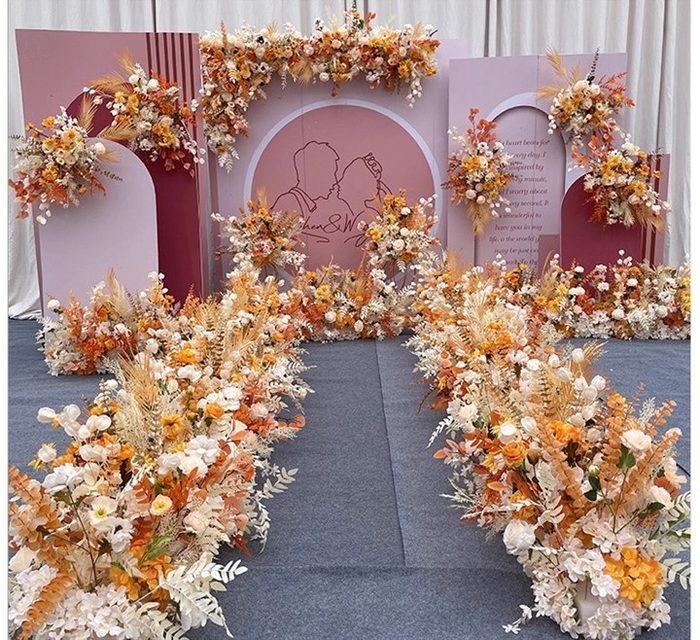
Artificial Wedding Flowers Decor
Ceremony Arch
Your ceremony arch is the backdrop for your “I dos.” It’s one of the most photographed parts of your wedding. Use knock-down structure arches that can be assembled and disassembled easily. The hinged foldable design makes transport and storage simple.
Floral Garland Arch: Wrap a garland of artificial greenery and flowers around the arch. Use bendable stem greenery that you can shape to fit the arch’s curves.
Full Flower Arch: Cover the entire arch with a mix of flowers and greenery. Use Mixed Color / Assorted Color blooms for a vibrant, abundant look.
Asymmetrical Arch: Cluster flowers on one side of the arch for a modern, asymmetrical look. Gradient / Ombre flowers add depth.
Hanging Flowers: Suspend flowers from the top of the arch, letting them cascade down. Use Artificial Vine / Garland as climbing or trailing decoration.
Bridal Bouquet
Your bridal bouquet is one of the most important flowers of the day. It’s in almost every photo, and it’s what you’ll carry down the aisle. The Stem Length of your bouquet should be comfortable to hold—typically 20–30 cm. The Number of Branches and Leaf Count determine the fullness of the bouquet. The Bloom Count (e.g., “A bunch of 6 flowers”) affects the overall size. Your artificial bridal bouquet is a lasting keepsake of your wedding day. You can display it in a vase, frame it in a shadow box, or simply keep it as a cherished memory.
Classic Round Bouquet: A tight cluster of flowers with a flower form that’s rose-shaped, daisy-shaped, or other classic forms. Use Single Stem Flower blooms for precise control.
Cascading Bouquet: Flowers that cascade downward, creating a waterfall effect. Use Artificial Vine / Garland for trailing elements.
Hand-Tied Bouquet: A loose, organic bouquet that looks like you just gathered flowers from a garden. Use Artificial Stem / Branch pieces for a natural look.
Single Stem Bouquet: A single, dramatic flower—a peony, a rose, an orchid. Overall Height should be appropriate for holding.
Centerpieces
Table centerpieces are a major part of your wedding decor. They set the mood for the reception. Choose Flower Head Size that’s appropriate for your tables. A diameter (in centimeters) of 8–12 cm is good for guest tables; larger blooms work for head tables. Spend more on bridal bouquets and ceremony flowers (where close-up photos matter), and more on centerpieces where guests will see them up close.
Tall Centerpieces: Dramatic, towering arrangements that make a statement. Use Artificial Tree branches or Artificial Stem / Branch pieces for height.
Low Centerpieces: Compact arrangements that allow guests to see across the table. Use small Artificial Potted Plant elements or Artificial Succulent clusters.
Flower and Candle Centerpieces: Combine flowers with candles for a romantic look.
Rustic Centerpieces: Wood slices, mason jars, and artificial greenery. Use Oval Leaf and Palmate Leaf foliage for variety.
Floating Flower Centerpieces: Flowers floating in water with gel beads or submersible lights.
Hanging Installations
Hanging flowers create a dramatic, magical effect. They draw the eye upward and fill empty space. Use lightweight flowers and greenery for hanging installations. Aluminum Wire is lighter than steel wire. Choose knock-down structure elements for easy transport.
Floral Chandeliers: Flowers suspended from the ceiling. Use Artificial Hanging Plant elements or create custom hanging arrangements.
Hanging Floral Garlands: Garlands suspended across the ceiling or along walls.
Flower Walls: A wall of flowers that guests can use as a photo backdrop.
Boutonnieres and Corsages
Boutonnieres and corsages are small but important details. They’re worn by the wedding party and close family. Keep these small and delicate. Use wire loops or metal clips for easy attachment.
Single Bloom Boutonniere: A single flower with a small leaf. Use a Single Stem Flower for precision.
Mixed Bloom Corsage: A cluster of flowers with a Number of Petal Layers that’s appropriate for the flower type.
Succulent Boutonniere: A small Artificial Succulent for a modern, boho look.
Cake Flowers
Flowers on the cake add a beautiful, elegant touch. Ensure the flower form matches your cake style. Rose-shaped or daisy-shaped blooms work with most cake designs. Remove any wire stems before placing flowers near food.
Cascading Cake Flowers: Flowers that cascade down the side of the cake.
Top-of-Cake Flowers: A cluster of flowers on top of the cake.
Floral Cake Wreath: A wreath of flowers circling the cake.
Flower Crowns
Flower crowns are a whimsical, boho touch for the bride, bridesmaids, or flower girls. Use wire loops or bendable stems that can be shaped to fit the wearer’s head. Flower Head Size should be small enough to look delicate but large enough to be seen in photos.
Rose Crown: A classic crown made of rose-shaped flowers.
Mixed Bloom Crown: A mix of flowers in assorted colors.
Succulent Crown: A modern, boho crown with small succulents.
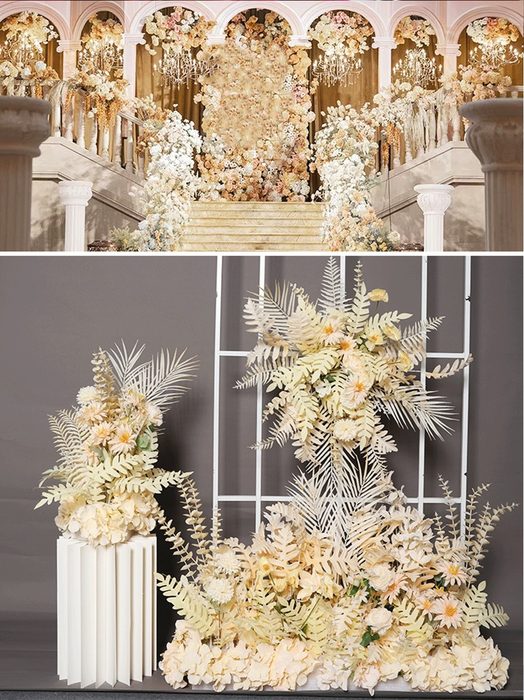
Artificial Wedding Flowers Decoration styles
The Color / Coloration of your flowers sets the tone for your entire wedding.
Solid Color: A single, uniform color. It’s simple and elegant. Solid color flowers are great for minimalist weddings.
Gradient / Ombre: A color transition from one shade to another. Commonly found in artificial hydrangeas and roses. Creates depth and visual interest.
Mixed Color / Assorted Color: Multiple colors in one bunch. Perfect for vibrant, bohemian weddings.
Natural Green: A blend of various green hues for a natural, organic look. Great for foliage-based arrangements.
Matte Finish: Non-reflective, for a more natural look. Almost always more realistic than glossy.
Glossy Finish: Waxy-like finish. Appropriate for some flowers (like calla lilies) but often overused on cheap products.
Planning Artificial Wedding Flowers
Artificial flowers give you incredible flexibility. Here’s a timeline:
6–12 months before: Start planning. Decide on your color palette, flower types, and budget. Research suppliers.
4–6 months before: Order your flowers. High-quality suppliers may have lead times of 6–8 weeks or more for custom orders.
2–3 months before: Receive your flowers. Check for quality. Fluff and arrange them.
1–2 months before: Finalize arrangements. Adjust any pieces that need adjustment.
2–3 weeks before: Pack and store your flowers. Keep them in a cool, dry place away from direct sunlight.
3–5 days before: Transport your flowers to the venue. Unpack and fluff them.
Wedding day: Set up your flowers. Enjoy your perfect day.
How to Choose Artificial Wedding Flowers
Artificial flowers are popular in weddings around the world, but cultural preferences vary:
North America: Heavy use of seasonal and tropical flowers. Popular choices include roses, peonies, and orchids. Artificial flowers have become increasingly popular for budget-conscious weddings.
Europe: More formal and structured arrangements. Popular choices include roses, lilies, and tulips. Artificial flowers are gaining popularity for their sustainability.
Asia: An emphasis on color and symbolism. Red and gold are popular. Artificial flowers are commonly used in banquets and festivals. Hong Kong weddings often include huge floral displays as photo backdrops.
Australia and New Zealand: A mix of European and tropical styles. The popularity of outdoor and beach weddings is driving demand for artificial flowers that can withstand the elements.
Middle East: Large, opulent displays with bold colors. Artificial flowers are popular for their ability to withstand heat and create dramatic displays.
Best Destination Wedding Practices
Hot climates: Choose UV Resistant / UV Protected flowers. Avoid fabrics that fade or melt in the sun. Choose PE or PVC for durability.
Beach weddings: Choose lightweight flowers that won’t be damaged by wind. Use bendable stems that you can shape to secure in sand.
Outdoor weddings: Protect flowers from sun and rain. Use UV coating to prevent fading. Consider weatherproof materials for outdoor arrangements.
High-humidity destinations: Choose flowers that are resistant to moisture. Avoid fabrics that absorb moisture and become heavy. Use plastic coated wire to prevent rust.
High-altitude destinations: Choose flowers that hold their shape at high altitudes. PE is a better choice than foam.
Your wedding day is one of the most important days of your life. Your flowers should be as beautiful as your love story—and they should last beyond the day itself.
Artificial flowers make this possible.
They’re budget-friendly, beautiful, and long-lasting. They’re available year-round. They’re weather-proof. They’re eco-friendly. And they give you the peace of mind that comes from knowing your flowers will be perfect, no matter what.
Whether you’re a bride on a budget, a wedding planner looking for new tools, or just someone who loves beautiful flowers, artificial flowers offer incredible design possibilities.
REQUEST QUOTE
Please fill out the form below and a representative will contact you. Thank you.
Sales Manager:Nina
Tel:
+86-19924394700
Email:
leafhometrade@gmail.com