How to Choose Between artificial grass and real turf?
The artificial grass vs. real turf debate isn’t about finding a “winner.” It’s about understanding the trade-offs and matching the right surface to the right application. There is no one-size-fits-all answer, and anyone who tells you otherwise is selling something.
A few years ago, I was working with a school district that needed to replace their aging sports field. The existing natural grass field was a disaster—patchy, muddy, and barely usable after spring rains. The maintenance team was exhausted. The coaches were frustrated. The budget was stretched thin.
The school board gave me two options: install a brand-new natural grass field with a modern irrigation system, or go with artificial turf. Both had passionate advocates. Both had loud critics. And both came with price tags that made everyone wince.
I spent three months digging into the research. I visited existing installations. I interviewed maintenance crews. I crunched the numbers. And in the end, I recommended artificial turf—but not without serious reservations.
How Big Is artificial grass Industry ?
The artificial grass turf market is massive and growing fast.
The global artificial grass turf market was valued at USD 7.43 billion in 2025 and is projected to grow to USD 13.2 billion by 2034, with a compound annual growth rate of 6.59%. Other estimates put the artificial turf market at USD 80.2 billion in 2024, growing to USD 141.36 billion by 2033 at a CAGR of 6.5%.
The sports turf segment alone accounts for 45% of total market revenue, with football pitches, hockey fields, and multi-sport complexes leading demand. Landscape applications are expected to grow at an even faster rate.
So why the growth? The artificial turf market is being reshaped by demand for durable, low-maintenance playing surfaces, drought-resilient landscaping, and multipurpose public spaces. In drought-prone regions like the American Southwest, homeowners and municipalities are turning to synthetic turf as a sustainable alternative to traditional grass lawns.
But growth doesn’t mean universal approval. Regulatory scrutiny around microplastic runoff, product recyclability, and installation best practices is increasing, prompting manufacturers to invest in circularity and end-of-life strategies. The industry is in transition—balancing mature manufacturing know-how with emerging sustainability expectations and application-specific performance criteria.
Upfront vs. Long-Term cost Between artificial grass and real turf?
artificial turf installation Costs
Let’s start with the number that matters most to most people: how much does it cost to install?
Natural Grass: Installing sod typically costs between $0.50 and $1.50 per square foot. Seeding is even cheaper. For a typical residential lawn, you’re looking at $4,500** for a professional installation. For a sports field on native soil (including irrigation), costs range from $1.50 to $3.00 per square foot.
Artificial Turf: Professional installation typically ranges from $5 to $20 per square foot, with most residential projects falling in the $10 to $15 per square foot range. For a typical lawn, installation costs around $9,000—roughly double the cost of natural grass. For sports fields, the upfront investment is significantly higher.
The Bottom Line: Natural grass is dramatically cheaper to install. There’s no contest.
Maintenance Costs
This is where the math gets interesting.
Natural Grass: Annual maintenance includes mowing, watering, fertilizing, aeration, pest control, and irrigation system upkeep. A low-input natural turf system might cost between $0.10 and $0.50 per square foot per year to maintain. For a typical lawn, that’s over $2,000 annually. For a high-use sports field, annual maintenance can easily reach tens of thousands of dollars in labor, water, and materials.
Artificial Turf: Maintenance is much lower but not zero. Annual maintenance costs are around $250 to $300 for a residential lawn. On a per-square-foot basis, maintenance can cost between $0.25 and $1 per square foot per year. For sports fields, maintenance costs are about $7,000 compared to **$50,000 for natural grass over a 25-year lifespan.
The Bottom Line: Artificial turf maintenance costs are a fraction of natural grass—roughly one-fifth to one-tenth of the cost.
The 25-Year View
Here’s where the long-term picture gets compelling.
A cost-benefit analysis from a 2025 case study revealed that natural grass offers a lower long-term expense over a 25-year period. However, other analyses show that over a 15- to 20-year period, artificial turf can be more cost-effective—especially when you factor in the elimination of watering, fertilizing, and mowing.
One installer calculated that over 20 years, artificial turf saves over $25,000 compared to maintaining a natural lawn. The water bill savings alone can be dramatic—some homeowners report drops of 80 to 90 percent in their water bills after switching.
Artificial turf is a “pay more now, save later” proposition. Natural grass is cheaper upfront but more expensive over time.
Daily Maintenance of artificial grass and real turf
Natural Grass: The Living System
Natural grass is a living system that grows and adapts. It needs:
Regular mowing (weekly during growing season)
Watering (thousands of gallons per season in many climates)
Fertilizing (seasonal applications)
Aeration (annual or bi-annual)
Weed control (ongoing)
Pest management (as needed)
Overseeding (to fill bare patches)
Natural grass also changes with the seasons. It goes dormant in winter, can brown in drought, and requires recovery time after heavy use. A natural grass field may only be usable for 200-300 hours per year before needing rest.
The upside: Natural grass is soft, stays cool, and provides ecological benefits like carbon absorption and temperature regulation.
Artificial Turf: The Manufactured Surface
Artificial turf is a manufactured surface made of plastic fibers, infill, and backing designed to replicate grass without biological care. It requires:
Periodic brushing to keep fibers upright
Infill top-ups as needed
Debris removal (leaves, dirt, trash)
Rinsing to manage pet waste, control odors, and remove dust
Cleaning and antibacterial treatments, especially if pets are using the area
Artificial turf is ready immediately after installation. It stays green year-round, even in shady areas or during droughts. It’s durable and handles high traffic well. But it’s not maintenance-free—homeowners often need to rinse the surface, particularly in hot weather, and apply water to cool it down.
The downside: Artificial turf does not support pollinators or beneficial insects, does not improve soil health, and does not contribute to carbon sequestration. It’s also not alive—it doesn’t adapt, recover, or grow.
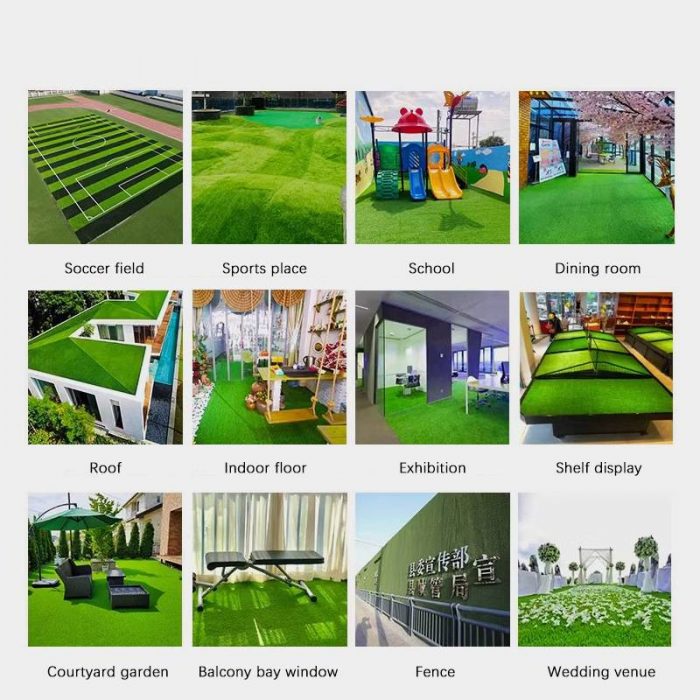
artificial grass vs. real turf: which is suitable for Applications?
When to Choose Artificial Turf?
High-Traffic Sports Fields: Artificial turf can handle 1,500+ hours of use per year compared to 200-300 hours for natural grass. It’s ideal for multi-sport complexes, schools with limited field space, and facilities that need year-round usability.
Drought-Prone Regions: In areas with water scarcity and strict watering restrictions, artificial turf offers significant water savings and maintains a green appearance year-round.
Shaded Areas: Natural grass struggles in shade. Artificial turf stays green and uniform regardless of light conditions.
Pet Areas: Artificial turf is durable, easy to clean, and eliminates muddy paws. Modern pet turf is made from non-toxic materials like polyethylene and nylon that are lead-free and won’t harm pets. It’s also hypoallergenic and reduces pests like fleas and ticks.
Rooftop Gardens and Balconies: The lightweight nature and low maintenance of artificial turf make it ideal for elevated spaces where natural grass would be impractical.
Commercial Landscaping: For office parks, retail centers, and other commercial properties that want a consistently green appearance with minimal maintenance.
When to Choose Natural Grass?
Environmentally Conscious Projects: Natural grass supports biodiversity, sequesters carbon, improves soil health, and reduces stormwater runoff. It’s the clear winner for ecological benefits.
Cooler Climates or Shaded Areas: Natural grass stays significantly cooler than artificial turf. In hot climates, this can be a major advantage for comfort and safety.
Residential Yards with Children: Natural grass is softer, cooler, and free from the chemical and microplastic concerns associated with artificial turf.
Budget-Conscious Projects: Natural grass has much lower upfront costs. If you have a limited budget and can manage the ongoing maintenance, natural grass may be the better choice.
Properties Where Resale Value Matters: Some studies suggest that homes with artificial grass sell for around 5.3% less than comparable houses with natural lawns.
Applications Where Appearance Matters Most: Natural grass has a texture, variation, and “living” quality that artificial turf cannot replicate.
The Hybrid Approach
For some applications, a hybrid approach works best.
Sports Fields: Some facilities use natural grass for the playing surface with artificial turf for the sidelines and surrounding areas.
Residential Yards: Consider using artificial turf for high-traffic areas (like a dog run) and natural grass for the main lawn.
Commercial Properties: Use artificial turf for entryways and high-traffic zones, and natural landscaping for the rest.
choice between artificial grass and real turf.
Artificial turf is better for:
High-traffic sports fields
Drought-prone regions
Shaded areas
Pet areas
Commercial landscaping where consistency matters
Applications where minimal maintenance is paramount
Natural grass is better for:
Environmental sustainability
Cooler surface temperatures
Budget-conscious projects
Properties where resale value matters
Applications where ecological benefits are valued
People who prefer the feel and appearance of living grass
The choice depends entirely on your specific situation—your climate, your budget, your maintenance capacity, and your values.
development trends in the artificial grass Industry
Cooling Technologies
Heat reduction is a major focus of research and development. Infrared-reflective pigments are being infused into turf fibers to reduce heat absorption. Sub-surface water storage systems that enable evaporation to cool artificial turf have shown promising results.
Sustainable Infill Alternatives
The European Commission adopted a restriction on intentionally added microplastics in 2023, including polymeric infill for sports surfaces with an eight-year transition period. This is accelerating alternatives such as:
Cork: Excels in athletic metrics—lowering injury incidence by 25% and increasing ball velocity by 15%
Sand: Cuts operational expenses by 50% and reduces carbon emissions by 90%
Coconut fiber, olive pits, and mineral infill are also gaining traction
Biodegradable biopolymers like PHACT™ PHA are being developed for turf infill
Recyclable Turf Systems
New turf systems are being designed for circularity. TenCate’s Pivot Performance Turf requires no performance infill and is able to be recycled. The system eliminates nearly 100% of plastic shedding because there’s no conventional infill, which causes abrasion and shedding. It also has no detectable PFAS.
ONE-DNA turf systems use a single polymer, making recycling easier, reducing waste, and transforming turf from a disposal cost into a valuable asset.
PFAS-Free Turf
Manufacturers are responding to PFAS scrutiny by developing turf systems with documented chemistry and safer material selection. PFAS-free turf is becoming increasingly available, and this trend will accelerate as regulations tighten.
Smart Turf
Artificial intelligence is improving artificial turf design, installation, and maintenance. AI-enabled image analytics, weather data, drone inspection, and sensor-based monitoring can help identify seam issues, compaction, infill migration, drainage concerns, and wear patterns before they affect playability. Predictive maintenance can reduce unplanned closures and extend field performance.
REQUEST QUOTE
Please fill out the form below and a representative will contact you. Thank you.
Sales Manager:Nina
Tel:
+86-19924394700
Email:
leafhometrade@gmail.com