
5 Future Amazing Trends in the Application of Artificial Plants in Interior Decoration
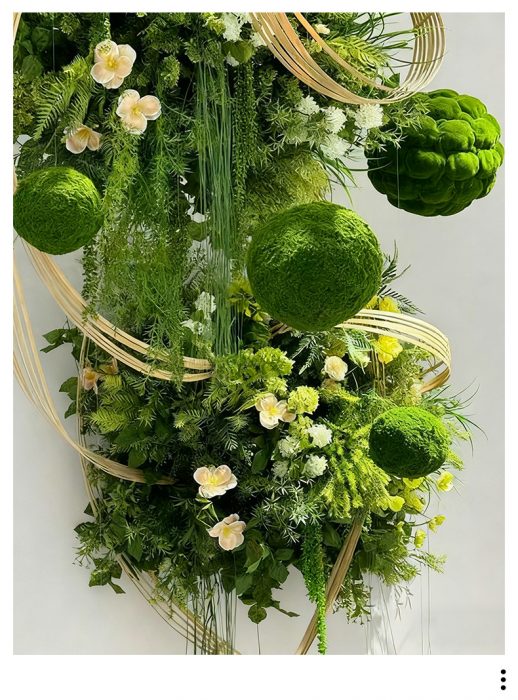
An “Arena” for Customization and Material Upgrades
The market is shifting from ready-made products to bespoke artificial trees. Simultaneously, technological upgrades are key, with a surge in demand for materials with fire-retardant properties and high-efficiency UV protection. The application of technology ensures that plants meet stringent fire safety standards.
As a “trendsetter” Artificial plants in interior decoration design and the hotel industry:
Artificial plants are deeply integrated with biophilic design, becoming an essential element in creating “healthy living spaces.” From luxury villas and high-end hotels to ordinary residences, artificial plants, due to their low-maintenance characteristics, have become a mainstream choice in interior design.
I. From the Perspective of Product Type and Material:
Product Type: Whole plants and trees are the largest segment, accounting for 40% of the total market. This is followed by stem flowers (25%), grasses (20%), and wood and branches (15%).
Material Trends: Polyester and plastic are mainstream, but materials such as silk and paper also maintain a share in specific areas. The market trend is towards higher-end, more realistic materials (such as PE) and products with UV-protective coatings, flame-retardant materials, and ultra-realistic textures.
II. Trend Insights into the Core Markets for Artificial Plants in the Future:
Seizing Emerging Markets such as Poland and Japan: Capitalizing on the two major windows of opportunity—regional distribution in Poland and functional aesthetics in Japan—to launch high-volume products using highly realistic PE materials and deodorizing series. The Japanese market particularly favors Wabi-sabi and minimalist aesthetics. Plants tend to be chosen from single-stemmed dead branches, bamboo, small succulents, and broad-leaved plants, integrating them with a restrained and natural style. In the Chinese market, the Neo-Chinese style is expected to continue to deepen, with consumers accepting plant styles that possess aesthetic appeal and cultural heritage.
Following the Upgraded Fulfillment Trends in the US and Germany: For large-scale commercial hotel projects in Europe and America, promoting environmentally friendly artificial greenery that meets UV protection and flame-retardant requirements, while simultaneously developing customized packaging for clients. Design trends are moving away from minimalism and towards more expressive and layered spaces. Mediterranean-style olive trees remain popular; however, in markets like the US and Latin America, large-leaved tropical plants are preferred.
Climate-driven: The UAE and Saudi Arabia are leading the transformation; Commercial-led: Large commercial projects (such as Dubai Hills Mall) are growth engines; High-end customization is evident. Due to extreme climates, ultra-realistic large-scale custom trees are widely used both indoors and outdoors. Commercial projects favor plants with broad canopies and tropical styles to match the resort atmosphere of high-end hotels and shopping malls. Custom plants can last 7-10 years without irrigation, meeting stringent local legal and ecological pressures.
South American market differentiation: Brazil has the largest market size, Chile/Colombia are growing rapidly; Consumer acceptance: Low maintenance and high durability are widely accepted; Home settings are the main growth driver.
Strong import and export demand. Latin America, the Middle East, and Africa are important growth markets. Argentine orders grew by over 101% annually, Chile by over 70%, and Saudi Arabia by over 40%. Vertical greening tends to be more practical, helping to cool and remove dust indoors. Buyers are increasingly demanding higher product quality, environmentally friendly materials, and supply chain efficiency, promoting industry consolidation.
III. Future Application Trends of Artificial Plants:
| Trend Dimensions | Short-term (1-3 years) | Medium-term (3-7 years) | Long-term (7-10 years) |
| Materials and Technology | Introducing safety standards such as flame retardancy and UV resistance; material upgrades. Integration with IoT sensors and smart lighting | strong interactivity. Popularization of next-generation sustainable materials such as plant-based materials | comprehensive environmental protection |
| Business Model | Focusing on commercial spaces | growth in modular applications. Popularization of bio-friendly design concepts | leading to solution-based sales. Exploring applications in specialized fields such as healthcare and education |
| Design and Aesthetics | Pursuing ultra-realistic details | style leaning towards simplicity. Emerging as unique art forms | moving from imitation to innovation. Standardized as “building materials,” permeating all spaces |
IV. Design and Aesthetic Evolution: From Consumer-Grade to Professional-Grade
- Aesthetic Revolution: Beyond “Deceptive Realism”
The future aesthetic standard will evolve from “artificial but extremely similar” to “a unique art form.” We will see more innovative designs that draw inspiration from art and natural forms but do not attempt to replicate any specific plant; artificial plants will become independent decorative art pieces.
- Standardization: From “Fragile” to “Building Materials”
In the future, high-performance, modular, and measurable products will be more favored by B2B users. Products will be required to integrate into spaces in a standardized, predictable, and durable manner, much like building materials, completing the transformation from “consumer goods” to “building and decoration materials.”
- Surrealist Style – Artificial Nature in the Digital Age
The manufacturing process of artificial plants is approaching precise replication in a biological sense. Multi-colored gradations of leaves, natural asymmetry, and even tactile coatings (mimicking the texture of real waxy leaves or velvety leaves) have become standard features of high-end products. The core of this style is that artificial greenery is displayed as independent works of art, becoming the visual focal point of the space.
In commercial spaces such as hotels and exhibition halls, large sculptural green plants create a dialogue with the high ceilings of the lobby, conveying a sense of relaxation and luxury while creating visual impact. Designers are treating large plants as “living sculptures,” serving as spatial anchors in open layouts, giving the space a sense of layering and a natural force field.
REQUEST QUOTE
Please fill out the form below and a representative will contact you. Thank you.
Sales Manager:Nina
Tel:
+86-19924394700
Email:
leafhometrade@gmail.com